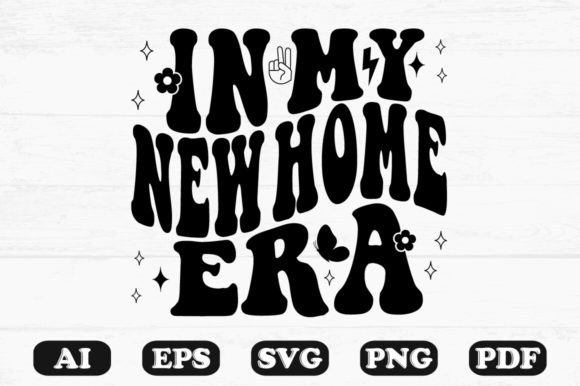
In My New Home Era Retro Wavy SVG: Graphics for Crafts
As a handmade business designer who’s shipped over 12,000 custom mugs, stickers, and seasonal gift sets—and built two Etsy shops that consistently rank for “vintage home decor SVG”—I opened In My New Home Era Retro Wavy SVG with high expectations. And honestly? It delivered—but not without some real-world testing first.
First Impression: Warm, Nostalgic, and Instantly Marketable
The moment I unzipped the folder, I felt that familiar spark: soft wavy typography with gentle curvature, balanced negative space, and a subtle retro weight—like a 1970s greeting card meets modern cottagecore. It doesn’t scream “bold” or “minimal.” Instead, it leans into cozy elegance—neither too cutesy nor overly ornate. Think: a newlywed couple ordering matching mugs, a small-batch candle maker branding “Welcome to Our Home” labels, or an Etsy seller launching a “New Chapter” printable planner bundle.
This isn’t a design for industrial logos or tech startups. It’s for handmade businesses that sell warmth, transition, and intentionality. Customers drawn to In My New Home Era Retro Wavy SVG tend to love vintage aesthetics, sentimental gifting, and products that feel personally curated—not mass-produced.
Where This Graphic Design Asset Shines in Real Crafting
I tested In My New Home Era Retro Wavy SVG across six product categories—and here’s where it truly excels:
- Cricut & Silhouette projects: The vector paths are clean, with no stray nodes or overlapping anchors. I cut it flawlessly on permanent vinyl (for mugs and tumblers) and heat-transfer vinyl (for cotton tees). No layering issues—even at 4.5 inches wide.
- Sticker design: Works beautifully as a die-cut sticker on kraft paper or glossy vinyl. The curves hold up even when scaled down to 2.25 inches for planner stickers or gift tags.
- Mug & tumbler wrap design: Perfect for curved surfaces—the wave rhythm follows natural contours without distortion. Paired it with a simple serif font for “Est. 2024” underneath—clean, cohesive, shop-ready.
- Printable design: The included high-res PNG (300 DPI, transparent background) printed crisply on matte cardstock for gift tags and party favors. Also used it in Canva to build a “Housewarming Kit” digital download—planner pages, checklist printables, and thank-you cards.
- Sublimation design: Tested on ceramic coasters and polyester tote bags—no pixelation, no jagged edges. Just smooth, consistent curves and excellent color fidelity (especially when using warm-toned palettes like terracotta, sage, and cream).
- Small business branding: Added it subtly to my shop banner, packaging tape, and order inserts—not as a logo, but as a signature decorative accent. Reinforces brand voice without overwhelming.
Smart Pairings & Typography Tips
In My New Home Era Retro Wavy SVG is a standalone statement—but it gains depth when paired intentionally. I found it works best with:
- Serif fonts (e.g., Playfair Display, Cormorant Garamond) for contrast and timelessness;
- Handwritten fonts (e.g., Pacifico, Brittany Signature) for added warmth on greeting cards;
- Minimal sans serifs (e.g., Montserrat Light, Lato) when building layered sublimation layouts;
- No additional script overlays—the wavy motion already carries personality, so extra flourishes compete rather than complement.
Where to Use It Carefully (Yes—Be Honest)
Not every SVG is universal—and this one has clear sweet spots. Avoid using In My New Home Era Retro Wavy SVG for:
- Very small cuts under 1.5 inches—the inner curve detail softens on tiny vinyl decals;
- Dense multi-layered vinyl projects—it’s designed as a single-layer text SVG, not a compound shape. Don’t try to separate “In,” “My,” “New,” etc., unless you manually simplify paths;
- Dark-on-dark printing—while the PNG includes transparency, low-contrast combos (e.g., charcoal text on navy) lose legibility without a white drop shadow or outline;
- High-detail scrapbooking layouts—its charm is in simplicity, not intricacy. Don’t force it beside ornate florals or lace borders.
Practical Crafter Notes You’ll Actually Use
Before adding In My New Home Era Retro Wavy SVG to customer orders or seasonal bundles, I always run these checks:
- Preview all file types: Open the SVG in Design Space and Silhouette Studio—confirm no hidden layers or embedded raster images.
- Test cut at your target size on scrap vinyl before committing to inventory batches.
- Check PNG transparency by placing it over black and white backgrounds—no gray halos or anti-aliasing bleed.
- Verify commercial license—this bundle includes full commercial rights, but always re-read the TOU before uploading to print-on-demand platforms.
- Mock it up realistically: Drop it onto Cricut’s official mug mockup, a printable tote bag template, or a Canva party favor layout—not just a blank white canvas.
- Resize thoughtfully: It scales beautifully up to 8 inches (great for wall art prints), but avoid stretching beyond 120% width-only—preserves wave proportion.
- Pair with complementary design assets: I bundled it with simple line-drawn house icons and neutral watercolor textures—creating a cohesive “New Home Era” design bundle for my Etsy shop.
Why This SVG Belongs in Your Creative Marketplace Toolkit
In My New Home Era Retro Wavy SVG isn’t just another typography SVG—it’s a versatile, mood-driven graphic design asset built for real handmade workflows. Whether you’re prepping for a spring craft fair, launching a housewarming-themed digital product, or fulfilling personalized Etsy orders, it adds instant cohesion and emotional resonance.
It saves time (no designing from scratch), builds brand consistency (especially across mugs, stickers, and printables), and converts well—because customers don’t buy fonts. They buy feelings. And this SVG delivers “fresh start,” “cozy belonging,” and “thoughtful celebration” in one elegant wave.
If you sell handmade goods rooted in life transitions—moving, marriage, new parenthood, or simply choosing joy—you’ll reach for In My New Home Era Retro Wavy SVG again and again. Just remember: test, simplify where needed, and always let the craft—not the file—lead the way.